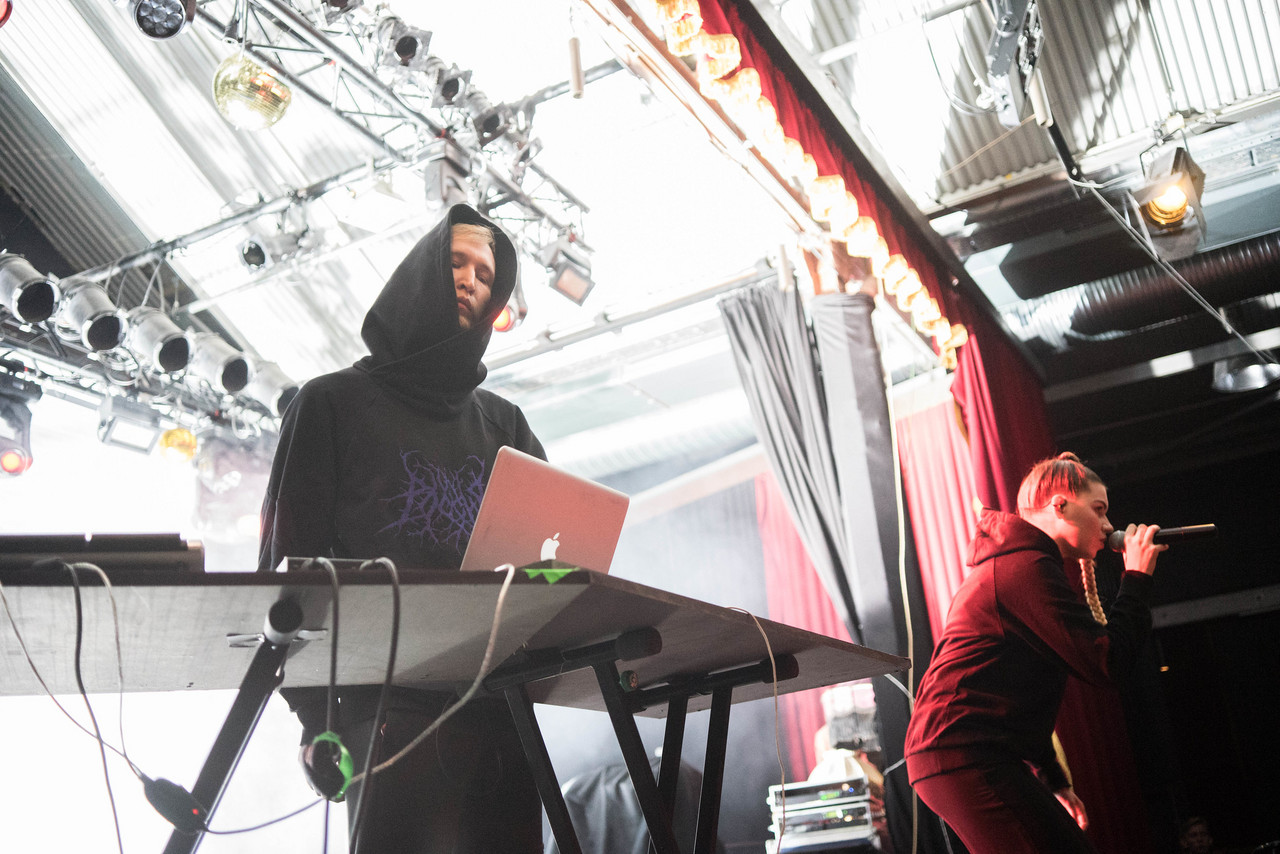
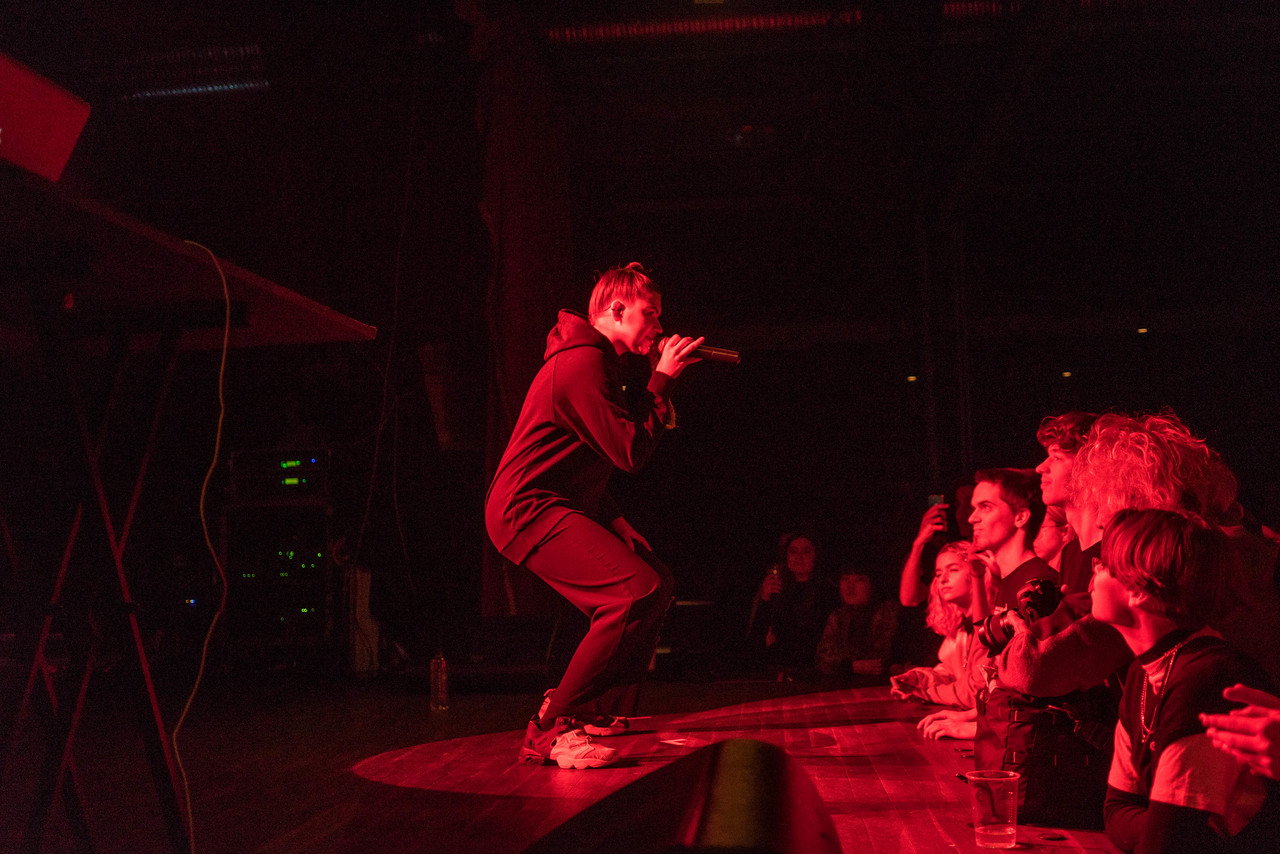
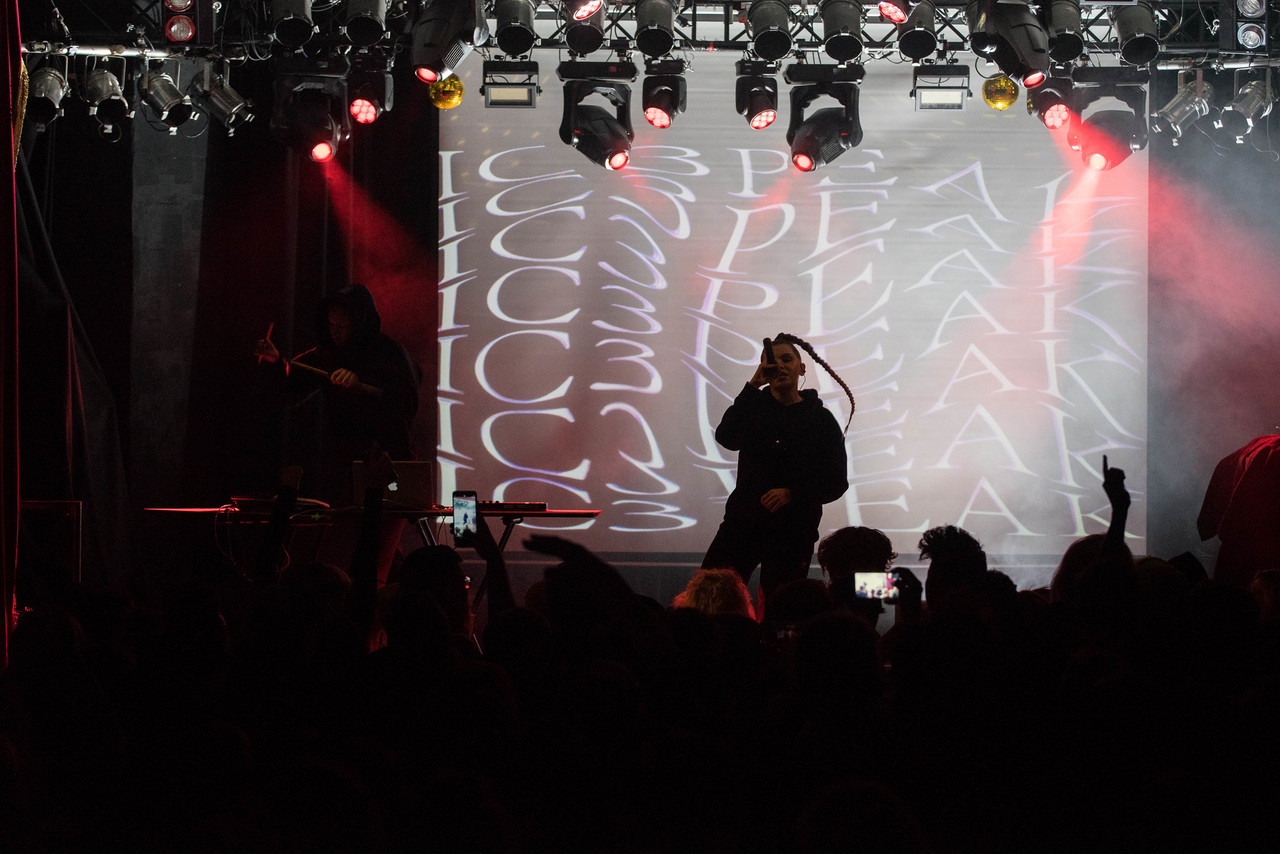
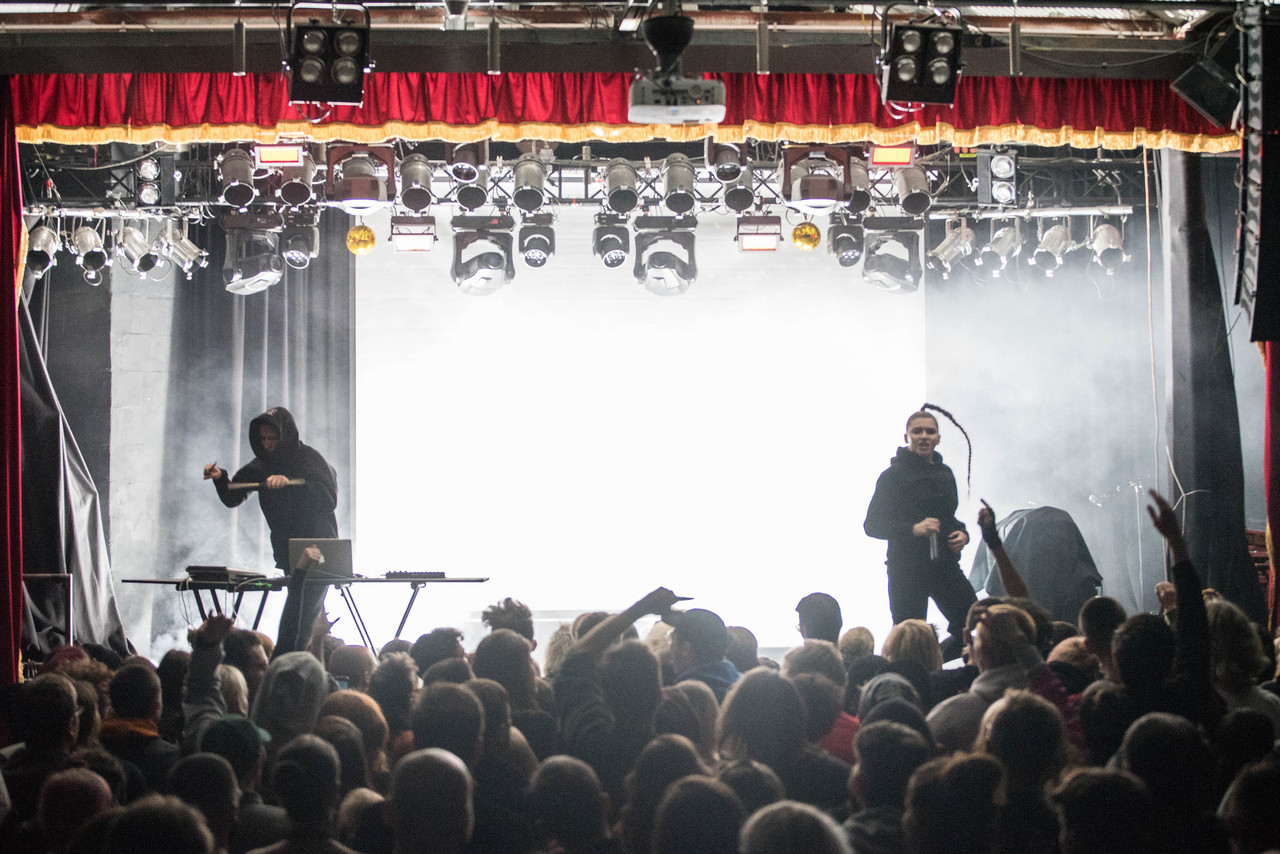
In 2018, the duo drew another level of attention. After their latest album, Skazka (or Fairytale), came out in September, IC3PEAK’s reputation ballooned past their fanbase, reaching Russian authorities and government-owned news channels. The scandals escalated a month later, after the artists released a video for the now-infamous »Smerti Bolshe Net« (or »No More Death«), in which Nastya and Nick drench themselves in kerosene in front of the Russian White House. They devour raw bloody meat with the Kremlin in the backdrop and ride federal police officers in front of the headquarters of the FSB (Federal Security Bureau, the main successor of the KGB).
Despite palpable tension and heated media discussions fueled by hatred and trolling, IC3PEAK still decided to tour Russia. They were apprehended and detained, missing gigs in the process. Promoters were threatened, and the duo’s manager was beaten up. Nonetheless, Nastya and Nick remained positive and kept sharing the incidents on social media, while the FSB’s outdated methods were watched, judged, and ridiculed across the web
IC3PEAK deliberately kept touring to make a statement against these pressures, hoping that their actions could serve as an encouraging example to their peers across the country. As is often the case with the citizens of Russia, in being truly patriotic, the young musicians do not wish to flee or emigrate; they want to persevere, drawing a staunch line between the country’s conscious youth and its deeply rooted dictatorship fortified in the Red Square.
Mariana Berezovska: The lyrics of your latest album, Skazka, are very straightforward. They are critical of the government and focus on anti-establishment sentiments. In an interview, Nastya mentioned that writing lyrics about dystopian themes made even more sense to her after Putin won the presidential election for the fourth time, in 2018. What caused the shift in your songs from existential issues to open political satire?
Nikolay Kostylev (Nick): I think that when Nastya started writing lyrics in Russian [in 2017], the country’s problems naturally entered the songs. But I wouldn't call all of our work political. In all of our latest albums, there are a range of themes and topics that we address. Sometimes they happen to be political. I think that real art is always created in the process of struggle, whether with ourselves or with the government, and our music has always been about emancipation and about »being against,« not »with.«
Anastasia Kreslina (Nastya): We sing about everything from love to politics. Everything human has its place in our music and my lyrics. Initially, we used words and voice like an instrument; they carried phonetic rather than semantic meaning. The abstract noise and screaming were comprehensible for listeners worldwide – it was a language of emotions that needs no translation. Now the message is more clear and direct, and yet allegorical. The latest album is a scary social fairytale, and we are its bewitched protagonists.
MB: IC3PEAK has been known to audiences in underground music circles for several years, but after recent stories emerged detailing the harassment you experienced at the hands of authorities and the pressures put on you by the government and the FSB, your level of fame rapidly took off. The funny thing is that now many listeners are grateful for the attention and criticism from authorities because it first introduced them to IC3PEAK. There are also many more haters, even among public figures like the renowned Russian filmmakerNikita Mikhalkov, who publicly analysed and criticised your songs. His remarks, according to Nastya, were just copied from popular YouTube comments. Does this have any negative influence on you, or is there no such thing as bad PR?
NK: Our music definitely got more exposure thanks to all of these problems with authorities and Siloviki [politicians from the security or military services, often officers of the former KGB, GRU, FSB, and SVR]. Of course, with more exposure comes more hate. There are people who are very far removed from this music and don't have the context to understand what we are talking about. But the reactions are mostly positive, because our songs vocalise what a lot of people want but don’t dare to say.
Mikhalkov’s comments are funny but they can also lead to something negative, because he is one of the main Russian propagandists. If they put so much effort into putting us on this list of »bad artists,« it means that they are really angry. And since we all know how the Russian FSB works, we also feel that it can be dangerous. At the same time, this propaganda does not work at all, because people who end up watching our videos don't rely on those comments and make their own judgments instead. Some viewers also thank Mikhalkov for the tip.
AK: I also don’t see any real problem here. Some people are scared of new things, and that’s fine. This is an educational moment – how else will people start perceiving other music if they don’t listen to it in the first place? Now they need time to comprehend the idea that having an alternative is very important. Fake and angry comments on YouTube are funny – they come from impotence and the fear of a new, powerful culture that won’t be stopped by prohibition. Many thanks to the FSB for the promotion!
MB: When it comes to censorship on social media in Russia, do you have to be careful with the ideas you express on different platforms?
NK: We don't try to be careful with our message. The only thing we want to avoid is having our videos age-restricted or blocked on YouTube. In the process of writing a script or directing or filming a video, we don't really think about any consequences. It’s in the process of post-production that we start to think about the parts that may be perceived as extremism or drug propaganda. Unfortunately, we sometimes even have to blur cigarettes in our videos.
AK: The most important thing for us is to be honest with ourselves and our listeners – to give people an opportunity to understand that they are not alone, and to show from our own experience that it’s time to stop being afraid of the dictatorship and to finally speak up. The prohibition of our concerts showed that publicity and information are our main weapons and that the media can provide enormous support.
MB: The Russian underground scene is growing, with young rappers taking the lead, touring the country in crews, and also receiving a lot of pressure from authorities. You are also often put in the same category of artists, but your language is very different from the majority of the scene: there are no swear words, no name-calling, no drugs. All of your songs are very symbolic. It must be difficult and frustrating to have your songs banned or censored – it doesn’t happen to rappers like Husky, for example. The same goes for your videos, which make use of a DIY approach and low budgets, yet everything is well thought-through and, again, very symbolic. Do you think this language is as understandable to young people in Russia as rap?
NK: Nastya’s language is poetic. That’s just the way she writes lyrics; everything is symbolic and has a deeper meaning. The same happens when we make a music video. We think of it as a movie and not as advertising for a song. Good movies usually have deep symbols and strong imagery, and that's what we want to see in our videos. Judging from the reactions our audience had to our latest album, we just express things that many people can relate to.
AK: You can only change culture through language, because language is culture. We all exist in the same kind of context – the same time period, which we reflect on. The rest comes down to artistic tools. Everyone understands and reads these signs, so of course we are also talking to our generation.
MB: From rapid media updates, we see IC3PEAK is being followed by the FSB. Alternative music concerts are cancelled, artists are detained and threatened. Putin meets up with rappers in the Kremlin to discuss their music and the influence they have on young people, aiming to interfere and get young influencers to be on the side of the government. It sounds quite dramatic and a bit desperate, but at the same time it proves that youth culture and underground music have their value and power.
NK: That we’ve been followed and detained by the FSB, and that our concerts get cancelled by Siloviki, really mean that our music is being recognised. But the thing is, these tactics are so ugly, old-school, and clumsy. They end up making fun of themselves – they try to censor rappers and cancel concerts before backtracking afterwards and saying that rap is good, or even trying to rap on state television like Kiselev did.
AK: It is youth culture that's shaping the generation that, in a few years’ time, will be deciding the future of the country. The Russian government suddenly woke up and realised that they are losing control and that there are many people beyond their influence. Alternative music has a strong effect on those people; to them, the authorities are just a joke. The government resorted to their old methods in hope of changing the situation.
MB: But do you think these old methods are just threats, or do you feel real danger to the point where you might need to leave the country? What would need to happen for you to stop writing and performing music?
AK: At the moment, most of the pressure comes from fake YouTube comments attempting to create a bad reputation for us. But still, the reactions of real people outweigh them. For me, it’s better not to do art at all than to be dishonest with myself. Perhaps what could stop me would be conditions in which speaking up was honestly impossible.
MB: Have you ever thought that living outside of Russia might make things easier for you?
NK: We are international musicians and can live wherever we want. We don’t want to leave Russia forever. There are no reasons for that. We have many fans in Russia and we love this country. It’s where we grew up and we feel like we belong here, even more so after this whole story with the authorities.
AK: I love Russia and I’d love to travel the world, but I wouldn't like to leave Russia forever. It’s not important where you are but rather which language you speak.
MB: I must say that in the Western press, the concept of Russia and Russian culture is often generalised based on what is known about Moscow or St. Petersburg. This is in spite of the fact that it is a huge country, and it would be logical for young people in different regions to develop their own interests and cultural movements. Do you think it’s important to understand the difference between various regions of Russia when speaking about musicians and their socio-political context?
AK: There is a common cultural code in Russia that glues everything together. Surely there is a difference between possibilities in Moscow and other regions, but young people who have access to multiple sources of information on the internet can think critically, and this is what unites all of us. And music, of course, is our common language.
NK: Russia is huge, and cities outside of Moscow and St. Petersburg, and maybe also Ekaterinburg and Kazan, are quite different. This applies to education and the environment there. But I wouldn't say that people we met during our time in the regions differ much from the youth in Moscow. We are all so heavily connected to the same sources of information that it feels like we're all neighbours. Of course, the internet doesn't solve all problems, and the environment in which these talented, bright young people live is much more severe than that of their Moscow peers. It’s sometimes depressing to see how talented people have to struggle just to do something simple like going to a gig.
MB: What do you think people outside of the Russian context should understand about the current music scene in Russia?
AK: The music scene has grown in recent years. We are not ashamed to say »we are Russians« anymore. But we also don’t want to scare anyone. We stand for dialogue and communication.
NK: Maybe outside of the country, Russian music and culture do not seem so big or interesting because most of it is in the Russian language. In actuality, we have a booming scene right now, and a lot of super-talented young singers, producers, and performers are emerging. People should definitely check out more music coming from Russia because the language barrier is not so difficult to overcome.