What is Noise Bombing?
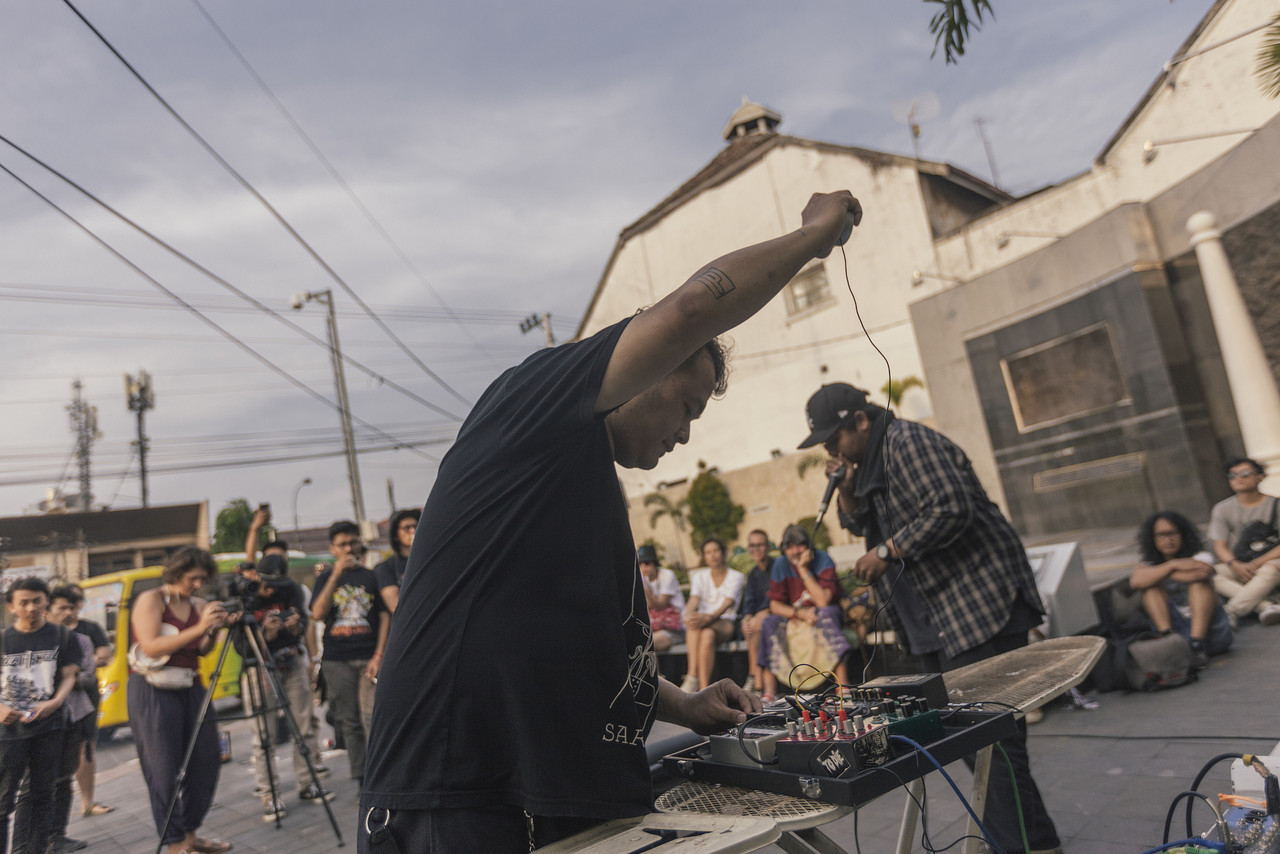
The concept of noise bombing is something that can baffle the uninitiated, those whose daily routines are momentarily interrupted by dissonance. Screeching sounds emerge from a mess of electronics, which are connected to small guitar amplifiers in front of traditional markets, college classrooms, or local parks. Onlookers might pass a judgemental eye on us and just see a strange group, all decked out in black clothing, circling unusual electronics. We cheer each other on as we abuse our speakers.
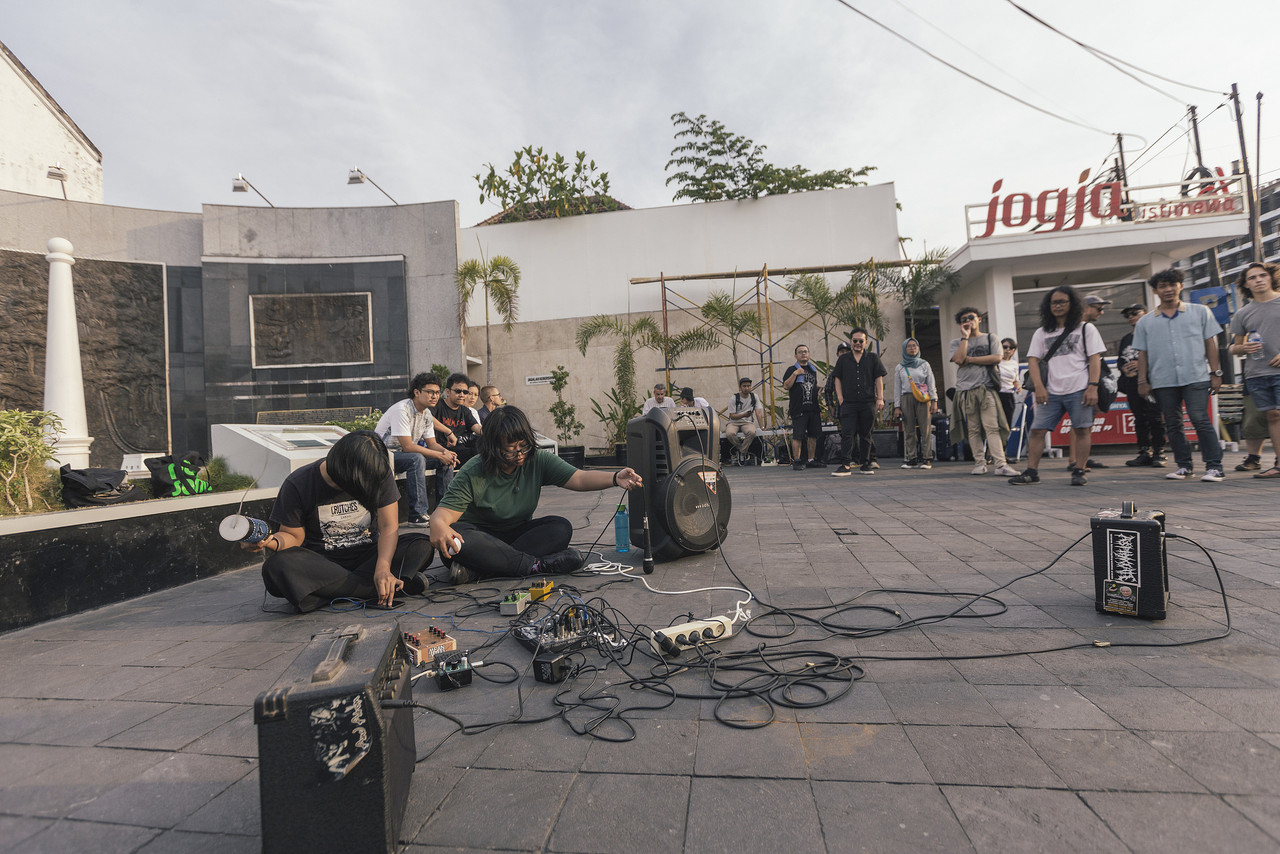
Sometimes security guards and local gangsters, known as preman, get involved in the action and try to shut down the jarring noise. When this happens, we quickly pack our gear and head for the next available electricity outlet, away from the previous confrontation.
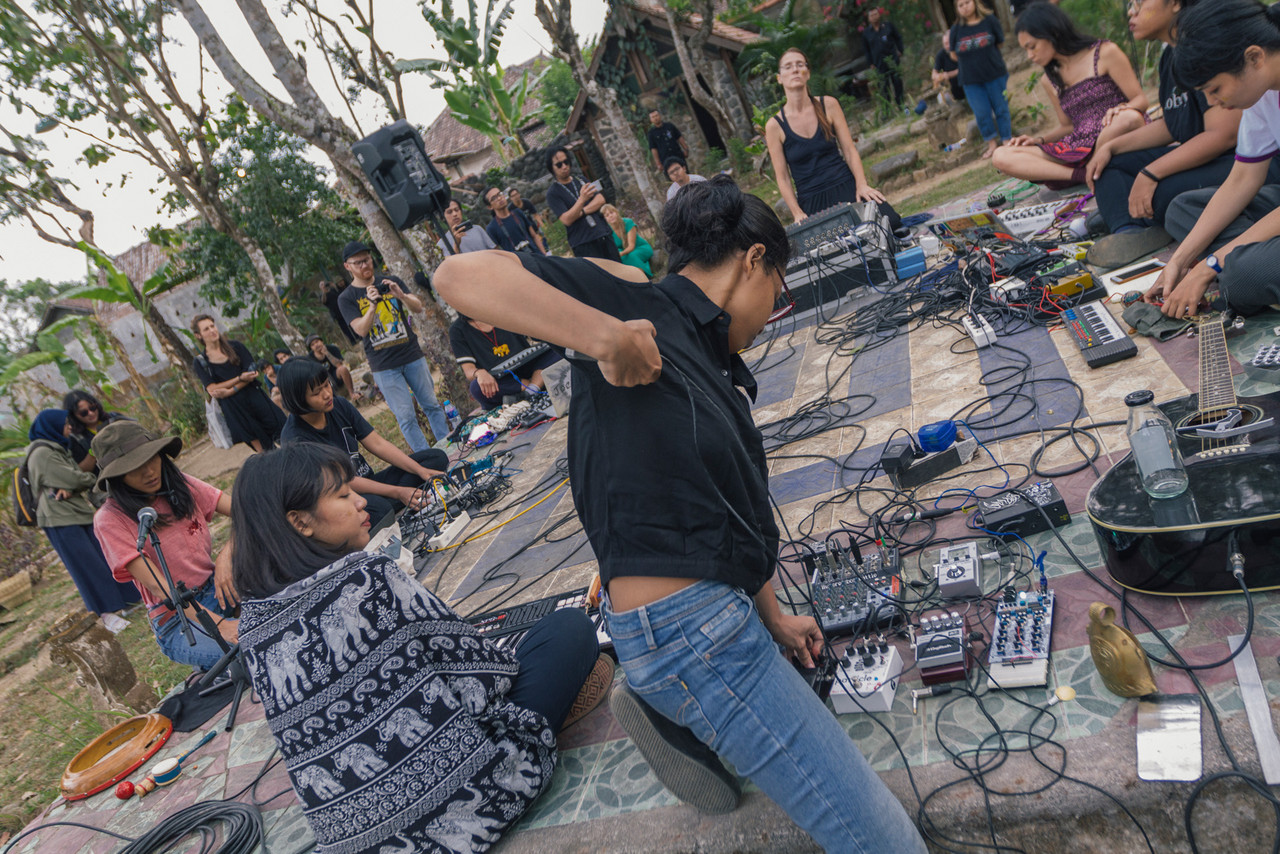
Other times, curiosity strikes and observers find themselves participating in the noise bombing. They enthusiastically twist knobs or hit metal objects connected to piezo microphones. These are the interactions that help us initiate more participants into noise; we welcome these encounters.
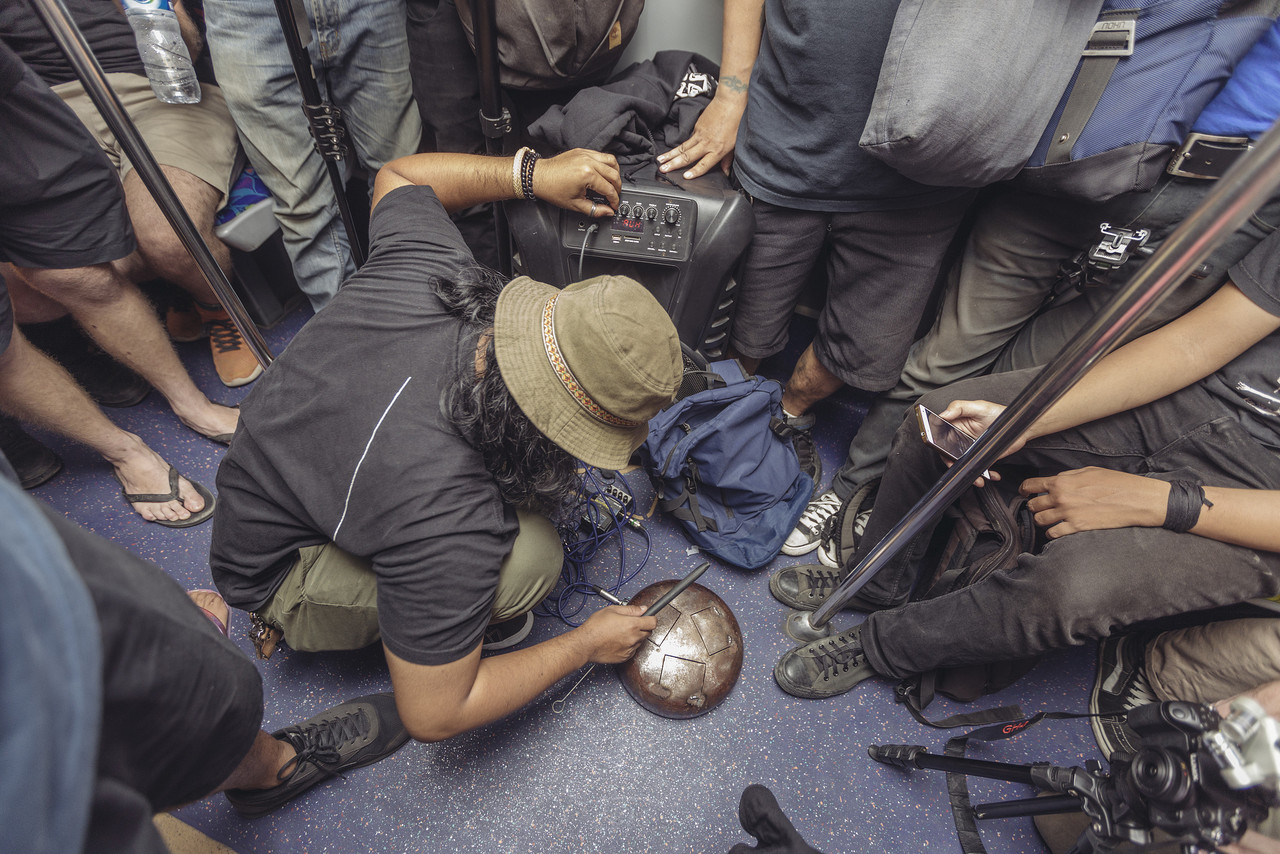
Noise bombing can be undertaken by a larger group, who might stake out locations over a few days, map out routes, and strategise their use of gear until it’s time to perform. It can also just be a few friends sitting around at a coffee shop using apps on their smartphones to create unusual compositions, to the dismay of other customers.
Anyone can join in noise bombing. There aren’t any real rules about participating. Noise bombers may seem unapproachable, but that is far from the case. We’re just a group of people who like to approach life from a different perspective.
Noise bombings can happen anywhere. Of course, it’s helpful to find locations where power won’t be an issue, so it’s best to find an exposed public electrical outlet. It’s also a good idea to test the outlets before we all gather and set up. Some reconnaissance and planning is smart, but not necessary.
But what is »noise bombing?«
We like to define noise bombing as a performance concept in which we host illegal noise gigs in public areas with stolen electricity. Noise bombing is inspired by graffiti bombing, and basically involves playing an impromptu collaborative set in public until security or local thugs stop us, after which we move to another site. We usually bring a minimal amount of gear and small combo amplifiers on our motorbikes, find an outlet, and then plug in and play.
However, it is much more than that. Noise bombing is a community banding together around a passion. It’s a way to infiltrate our local art and music scenes and bring exposure to the sounds of the underground. Noise bombing is a way to relieve the day-to-day problems and stresses we encounter. Noise bombing is also a reflection of the noisy city in which it was founded; like noise bombing, Yogyakarta is loud, unusual, and intriguing.
The Experimental Noise Scene in Yogyakarta
Before discussing Jogja Noise Bombing (JNB), it would be helpful to outline a brief history of noise and experimental music in the city that gave JNB its name.
Musically, Yogyakarta can be divided into two territories: the south and the north. In the south, the music scene is predominantly comprised of artists and art students, as the art college, Institut Seni Indonesia (ISI Yogyakarta), is a central influence. This part of the Yogyakarta music scene is filled with experimentation, art, and political discourse. In the past, many experimental noise bands and musicians in the south often performed at art exhibition openings. Conversely, the music scene in the north has traditionally focused less on experimentation and art, instead emphasising music for parties, and the music industry. Most of the musicians in the north are students of the many colleges throughout Yogyakarta. Despite these differences, both scenes have recently started working together in organising music events, and the borders between north and south are starting to blur.
Experimental music is nothing new to the city. One of the earliest examples of experimental music performance in Yogyakarta happened in 1995, at the Recycle Music event held at ISI Yogyakarta. Recycle Music was an event that tried to combine the conventional format of a stage show with fine art concepts. Music at the event was very different from the usual local stylings of sampak, dangdut, or traditional rock music. This marked the emergence of a new spirit among the students – an alternative spirit that was focused on being »different from the others.« This alternative spirit was demonstrated in the way Recycle Music’s stage was set up; musicians were locked up in a cage under a large tree, while spectators arrived in all manner of unusual costumes. In the past, a few art students from the south had become familiar with musicians from the north, for example the group SKM (Sejuta Kata Makian) fronted by Ari Wulu and Jompet, as well as Marjuki »Kill The DJ« (through the »Mencari Harmoni« and »Parkinsound« series of events). Prior to that, there was also a phenomenal experimental rock band known as Steak Daging Kacang Ijo, who ransacked many different styles of music to create their own. Members Bob Sick, S. Teddy, Yustoni Volunteero, and Edo Pillu created interesting music not only because they didn’t know how to »properly« play their musical instruments, but also because they were active during Soeharto's New Order. The members of Steak Daging Kacang Ijo were artists whose artistic approach was very different from conventional musicians. »It's a happening band,« said Toni, drawing on the concept in the art world. Between 1990 and 2000, there were many bands that went »beyond the band,« in the sense that they also worked with visuals and stage performance, as evidenced in the work of political techno/digital hardcore band Techno Shit.
Yogyakarta art exhibitions are enlivened by creative music performances exploring experimental sonics, noise art, and sound art. One early example of this took place in 2003, when Yogyakarta visual artist Eko Nugroho hosted an exhibition at Gelaran Budaya, called Sound Garden, which combined sound art with visual art.
In the heyday of the internet, the phenomenon has reemerged as a result of internet-savvy artists harnessing the magic of the network. Wok The Rock started his net label Yes No Wave, which provided a space for the production of music not absorbed by major labels. He focused on Yogyakarta groups, giving them a platform through which to share their music with larger audiences outside the city. One of the biggest and most influential bands to be released on Yes No Wave is Seek Six Sick, a noise rock band founded in 1999 and made up of art students.
This band would go on to be one of the core influences for the next generation of noise and experimental artists in the 2000s. Many of the band’s younger fans developed an interest in noise and fell down the rabbit hole. This is true for many of the founding members of Jogja Noise Bombing, who used the chaotic sounds of Seek Six Sick as a launching point for their own noise projects. Jimmy Mahardikha and Sony Irawan, the core line up of the band, call their music »Asian noise rock.«
One of Seek Six Sick’s vocalists, Bofag, also plays with Jimmy and Levoy (who drums in grindcore bands Extreme Hate and Proletar) in the noise-grindcore band Sound of Human Pollution. They appended noise samples to the starts and ends of their fast, short old school grindcore tunes – something that had never been done before in Indonesia. Sound of Human Pollution's discography is now considered to be very influential in this realm.
The influence of Seek Six Sick's brand of Asian noise rock was first evident in the younger generation at ISI Yogyakarta, specifically the group Black Ribbon. They started integrating noisy parts into their rock music, and added a noise component via Krisna Widhiatama, who rounded out the sound of Black Ribbon DJing cassettes and playing circuit-bent instruments.
Krisna Widhiatama himself then founded the harsh noise acts Feces Anatomy and Sodadosa. Together with Dyah »Woro« Isaka, Krisna later formed the drone noise duo Sulfur. He would eventually play a pivotal role in the emergence of Yogyakarta noise acts in the late 2010s, such as Asangata, Bangkai Angsa, Liwoth, Bleak, and many more.
Wednes Mandra, another key figure in the Yogyakarta experimental music scene, was involved in countless noise projects including noise-focused netlabel called Pati Rasa Records, and was also a founding member of Jogja Noise Bombing, participating in the very first street noise bombing. However, after forming the dark folk duo Rabu, he disbanded all of his noise projects.
In the late 2000s and early 2010s, several initiatives started to make connections between experimental noise music and new media art. Breakcore_LABS, a platform for experimental audiovisual performance, formed. Lifepatch, an independent community-based organisation working in art, science, and technology, was founded by a team that includes Andreas Siagian (Ucok).
Bukan Musik Bukan Seni Rupa (BMBSR) was held in 2013 at ISI Yogyakarta campus and curated by Rain Rosidi, Krisna Widiathama, Ahmad Oka, and Koskow Widyatmoko. Initiated to showcase the latest developments in Yogyakarta’s creative arts scene, the event was presented in two sessions: the first consisted of a noise performance followed by sound art interventions, while the second was an attempt to present a meeting between sound and visuals. The event attempted to explore the unnamed, hazy area of »non-music non-art,« hence the title of the event, Bukan Musik Bukan Seni Rupa.
Electrocore, an act comprised of Venzha and Istasius, is one of the key bridges between noise and new media art. Both members helped found the House of Natural Fiber (HONF), an international new media art organisation based in Yogyakarta. As Electrocore, they toured Europe in the early 2000s, gaining notoriety because of their interest in UFOs. I remember watching Electrocore back in the early 2000s, when Venzha wore a big instrument reminiscent of a space suit that could capture sound waves using various sensors. The instrument generated sound using signals and frequencies from the human body, plants, water, and the surrounding environment.
SKM, the brainchild of Ari Wulu and Jompet, is another influential project from Yogyakarta. Formed back in the early 2000s, the act performed their compositions on a bicycle. Jompet is an artist and also a pioneer of electronic music in Yogyakarta who started Garden of the Blind together with Venzha. Ari Wulu is known as the godfather of electronic music in Yogyakarta in addition to founding the underground DJ collective Soundboutique. His father, Sapto Raharjo, was probably the first person to bring a synthesiser to Indonesia. Ari Wulu is also known for mixing electronic music with gamelan, and establishing acts Second Floor, Midi Junkie, and WVLV.
In the mid-2000s, the indie-pop scene in Yogyakarta flourished thanks to influential communities such as Common People. The band Melcyd found themselves more drawn to noise than indie-pop, and their sound grew noisier over the course of their career.
Bhakti, Melcyd’s bass player, went on to play in experimental outfit Zoo with Rully Shabara, who would later form the influential Senyawa with Wukir Suryadi. Their singular sound combines Wukir's handmade bamboo instruments, guitar effects pedals, and Rully's diverse vocal stylings, embracing Indonesian ethnic music with hints of noise.
To Die was started as a three-piece hardcore punk band in 1998 by me (Indra Menus) and my high school friends. Our interest in bands such as Man Is the Bastard and Bastard Noise led us to shed our hardcore punk sound and embrace the spectrum of noise. Now we are cited as the band that bridged the gap between the Indonesian hardcore punk scene and the Indonesian experimental and noise scenes, and To Die was also one of the initiators of Jogja Noise Bombing alongside younger members of the local noise community.
Today, Yogyakarta’s experimental noise scene is more developed, consisting of a wide array of participants. Musicians from other genres have started noise projects; enthusiasts from the grunge, metal, and hip-hop scenes have crossed over. A fan of J-pop idol groups now uses samples from AKB48 in noise compositions.
In the mid-2010s, Jimmy Mahardikha of Seek Six Sick and Satya »Panca« Prapanca launched a series of improvised music concerts known as Kombo. The concept was simple: feature a number of musicians from different communities, have them form duos, and then improvise together. Each performance would last about 10 to 15 minutes, and there would be several combinations of performers during an event. At the end, all performers would come together for a final improv session. Kombo successfully brought musicians from different disciplines together, providing musicians with the chance to experiment with their approach toward music writing for the first time.
Experimental music projects continue to exist in Yogyakarta, one example being Raung Jagat – an experimental choir led by Rully of Senyawa. Developing a unique code system with which to conduct the ensemble, Rully also established an offshoot instrumental project called Gaung Jagat.
Meanwhile, the Yogyakarta Synth Ensemble, which started as a synthesiser-building workshop conducted by Kenali Rangkai Pakai, is still active. The ensemble uses their own DIY synths as well as a particular notation system they created. At the same time, Klithih Bunyi began to fill a computer music vacuum with their laptop-driven improvised compositions. The Ruang Gulma collective organises regular experimental noise jam sessions under the Ngaji Swara banner. Ruang Gulma is also behind Terik Berisik, which organises gigs for out-of-town experimental noise projects that come to Yogyakarta.
The city enjoys an array of experimental music events, such as the legendary Yes No Klub. Established by Wok The Rock of Yes No Wave and Tim Puk of Performance Klub/Oxen Free, Yes No Klub, in their own words, is »a curated series of events concentrating on cultural and musical exchange between visiting and local artists.« They »range from experimental/sound oriented performances through to more conventional band and electronic performances,« and try to expose the people of Yogyakarta to new and unfamiliar sounds. They also »aim to link artists from Indonesia to an international network of experimental/other musicians and sound producers.«
As for record labels, my own Relamati Records, established in 2002, is still actively releasing experimental noise music in a variety of physical formats. Tilis Records, a new record label, releases improvised experimental music from projects such as Potro Joyo, Wukir Suryadi, and Ikbal S Lubys of Sangkakala. 10 PM Project, run by Rio Nurkholis of Coffee Faith, focuses on CD-r, while Mindblasting Netlabel releases free digital downloads. New net labels such as Watch Pineapple Press are now active, trying to help experimental bands release their albums digitally.
Challenging, caustic sounds were around Yogyakarta well before JNB filled the streets with a cacophony of noises. Art was fundamental in exposing the sounds and concepts found in these styles of music to a wider audience. This, coupled with a continued desire to push boundaries, has also helped move these sounds from art to music communities. With members rooted in both scenes, Jogja Noise Bombing was also able to influence current trends, and has helped to bring more national and international recognition to Yogyakarta as a city filled to the brim with experimental and noise music.
How Jogja Noise Bombing Exploded onto the Scene
Jogja Noise Bombing (JNB) is an open community and collective known for organising performances, exhibitions, and workshops. Also heavily involved in the international noise network, JNB organises festivals, tours internationally, and contributes to releases with international acts.
The seeds of JNB were planted in the years 2009 and 2010 by affiliates of net labels Ear Alert Records, run by Hilman Fathoni, and Pati Rasa Records, run by Wednes Mandra.
Both labels have shared music from Yogyakarta noise artists such as Martinus Indra »Menus« Hermawan (To Die, Relamati Records), Hendra Adythiawan (Anxiety/Anxiety Alone), Rangga Nasrullah (Anxiety), Krisna Widiathama (Sulfur, Sodadosa), Hilman Fathoni (Palasick, Ear Alert Records), Wednes Mandra (Asangata, Liwoth, Bangkai Angsa, Pati Rasa Records, amongst many others), Pandu Hidayat (Control Z, KontrolJet), Taufik »Arie« Aribowo (Hartz Hertz, Suffer In Vietnam, Mindblasting Netlabel), Akbar Adi Wibowo (ULO, Evil Jazz Mortus, Radio Active Morbid, Giga Destroyer), Vitus Yogi Prasetya (Obluda, Jurumeya), and Dyah »Woro« Isaka (Sulfur, Menstrual Synthdrone).
In the early days of JNB, local noise musicians always faced difficulties in booking shows, because organisers and venue owners feared that noise would destroy their amplifiers and PA systems. This lack of venues drove us to create something new. Once we got kicked out of a spot, we would then move to another location and do it all over again. This concept is part Occupy, part punk rock, and part DIY synth culture.
The gear and instruments JNB artists use tend to be mostly homemade. This is in part due to the cost of imported guitar pedals and electronic music equipment, but also because of the scene’s DIY-focused creative culture. Some musicians use instruments built from scrap metal and springs, while others use DIY synthesisers and pedals built from various makers around Indonesia. Many of these synths are made by Yogyakarta native Lintang Radittya and his company Kenali Rangkai Pakai (KRP). These instruments have played an important role in shaping the sound and tone of many JNB artists, and Lintang has also helped inspire plenty of instrument building.
JNB has conducted noise bombings almost anywhere power can be found, such as university campuses, parks, and street intersections. Other noteworthy venues include the Taman Kuliner (Culinary Park) where a video of local security kicking us out went viral; a Tong Setan (Wall of Death), where motorcycles ran in circles above us; and Tugu, a sacred and historical monument in Yogyakarta. For noise bombings, we don't care where we play.
Our early noise gigs received full support from local promoter Irvin Domi, who organised a gig for us called XYZ. He also helped us with our noise bombing efforts by providing a pickup truck to take the artists and equipment all around Yogyakarta. Irvin Domi also documented the early JNB performances and street performances through his production company, Snoop Doc. After a little while, Domi moved to Jakarta for work. His role of documenting JNB events was then taken over by Udin (Otakotor Records) and Fahrul (Disgusting Tapes).
In the early days, JNB mostly held illegal noise shows in public and on the streets. Now, we’re no longer limited to stealing electricity from outlets. We have performed in art galleries, fried chicken restaurants, coffee shops, and abandoned buildings. Even when we do noise bombing in indoor venues, we still try to apply the concept of our street performances to the venues we play in. This means that we try to make sure performances are short (usually 20–30 minutes maximum), and involve impromptu collaborative sets between performers. The idea is to keep our shows similar to how we would play when we were on the street.
We also host the yearly Jogja Noise Bombing Festival, where we try to bring the atmosphere of street-level noise bombings to larger venues. We pair two different noise acts (that have never collaborated before) together, and have them play a 30-minute set. With this concept, we want to encourage performing artists to create new connections. Pairing artists also allows them to discuss their performance with each other and create music that is unique for the festival. We believe that with this concept, musicians will be able to establish a strong connection, with the hope that they can build on this after the festival. This concept has been especially great in recent years, as we have been able to connect local and international artists.
Many international noise acts have come to play in the annual Jogja Noise Bombing Festival. So far, we've had artists from the USA, France, Australia, New Zealand, Japan, Singapore, Malaysia, Belgium, the Netherlands, Myanmar, and many other countries. Some of the artists who have played with us or at our shows include DJ Sniff, Bob Ostertag, Ora Iso, Gisle Froisland, Tzii, DJ Urine, Jerk Kerouac, sIn, and Circuitrip.
Some return time and time again. The camaraderie between them and the hosts, as well as the family vibe, are part of why these artists keep coming back, and why they champion JNB back home. After the festival, we usually go to local food stalls such as Angkringan Padang Amien Rais to enjoy a delicious wrapped rice with petai and jengkol in Padang-style chilli, and the sound of noise is then replaced by conversation between friends.
In addition to the annual noise festival, JNB also organised the Jogja Noise Bombing Week – a week full of workshops, exhibitions, movie screenings, gigs, and discussions that revolved around the experimental noise scene. Another JNB-organised event was Persami Eksperimental (Experimental Weekend), which was a two-day camping excursion at Kampung Edukasi Watu Lumbung (Watu Lumbung Educational Camp), near Parangtritis Beach. This event saw the debut screening of Hilman Fathoni’s documentary about the development of noise in Yogyakarta, Noise Is a Serious Shit.
In addition to being accepted by the art and music scenes, JNB has also attracted the attention of Yogyakarta’s academics, becoming the subject of several student theses, and receiving media attention.
As of 2018, JNB has undergone many changes in membership. Some of the earlier noise bombers are no longer associated with noise music, while some continue to keep the spirit of street noise alive. Some still live in Yogyakarta, while others have now left for other cities or countries. The fluid nature of JNB makes it easy for acts to become part of the community, but also means that they might not be willing to prioritise it. It’s better to think of JNB as a loose collective of outsiders who gather around a love for strange sounds, rather than a professional organisation with strict guidelines for membership.
Aside from the first generation of noise bombers who started in 2009, there are newer members of the scene that have become core members of JNB, such as Mahamboro (who also plays sax in To Die), Made Dharma (Mad Dharma, (((...)))), Rio Nurkholis (Coffee Faith, 10 PM Project), Bodhi (Rupagangga), Gendes (Tsaatan, ASU(USA)), Lansanese (drums in in To Die), Dea Karina, and Sean Stellfox (Bossbattle, ASU(USA), Lansanese, Stellfox).
At this point, JNB has been around for almost a decade. We started bombing the streets of Yogyakarta with noise as a result of not being able to find a welcoming space to perform. As we performed our street noise, we gathered more and more interest. While we may have made a few security guards angry in the process, this just served as validation. The positive reception from casual observers was always much stronger than the negative. Eventually, we were able to transition from street noise bombing into becoming one of the staple experimental music communities in Yogyakarta. We’ve found acceptance from the same places that once shunned us. However, we’re still on the fringe. Others might accept what we do, but that doesn’t mean they fully understand it. To be honest, we wouldn’t have it any other way. As long as we can find an open electrical outlet, we will continue to plug in our amps and just have fun making noise.