Hailing from Ontario, Canada are A Tribe Called Red, a native producer and DJ crew blending elements of hip hop, dubstep, and house with traditional Pow Wow songs and drumming. Now comprised of Tim »2oolman« Hill (Mohawk, of the Six Nations of the Grand River), and Ehren "Bear Witness" Thomas (of the Cayuga First Nation), ATCR are a testament to the enduring strength and importance of Indigenous culture.
»If you’re an Indigenous person living in a country that was forcefully colonised, it’s all too common to find yourself underrepresented and misrepresented if not blatantly and systematically devalued and attacked. Positive role models and a positive self-identity are hard to come by, yet the Canadian DJ collective A Tribe Called Red is a modern gateway into urban and contemporary Indigenous culture and experience, celebrating all its layers and complexity,« reads the group’s website. Against all odds, and against systematic erasure and oppression that continues well into the present day, Indigenous cultures have persisted and are reinventing themselves. In parallel to ongoing community efforts of documenting, preserving, and re-learning what little linguistic knowledge, histories, customs and beliefs of these civilisations can still be found, is a movement of artists, musicians, dancers, writers, and poets that imagine and experiment with modern and future identities of their (urban) Indigenous communities. Artists such as ATCR are a crucial part of this movement.
Since forming in 2008, A Tribe Called Red have established their voice in an essential renewed aboriginal rights movement known as Idle No More. It’s no accident that the late native (Santee Dakota) activist, poet, and musician John Trudell is the first voice you hear on the collective’s third and most recent album, We Are The Halluci Nation (2016), as the group considers him a forefather for this movement. The concept album features the stories of aboriginal voices, addressing the impact of colonisation on Indigenous people in the modern world. Trudell’s lyrics open the record, defining the Halluci Nation as »the tribe that they cannot see,« who »see the spiritual in the natural.« This stands in contrast to the oppressive ALie Nation, who »see the material religions through trauma [where] nothing is related, all the things of the earth and in the sky have energy to be exploited.« Featuring collaborations with artists such as rappers Yasiin Bey (formerly Mos Def) and Saul Williams, Polaris Prize-winning singers Tanya Tagaq and Lido Pimienta, in addition to Manawan Atikamekw Nation drum group Black Bear, Australian aboriginal band OKA, and Swedish-Sami singer Maxida Marak, the record’s empowering anti-colonial message is poetic and clear.
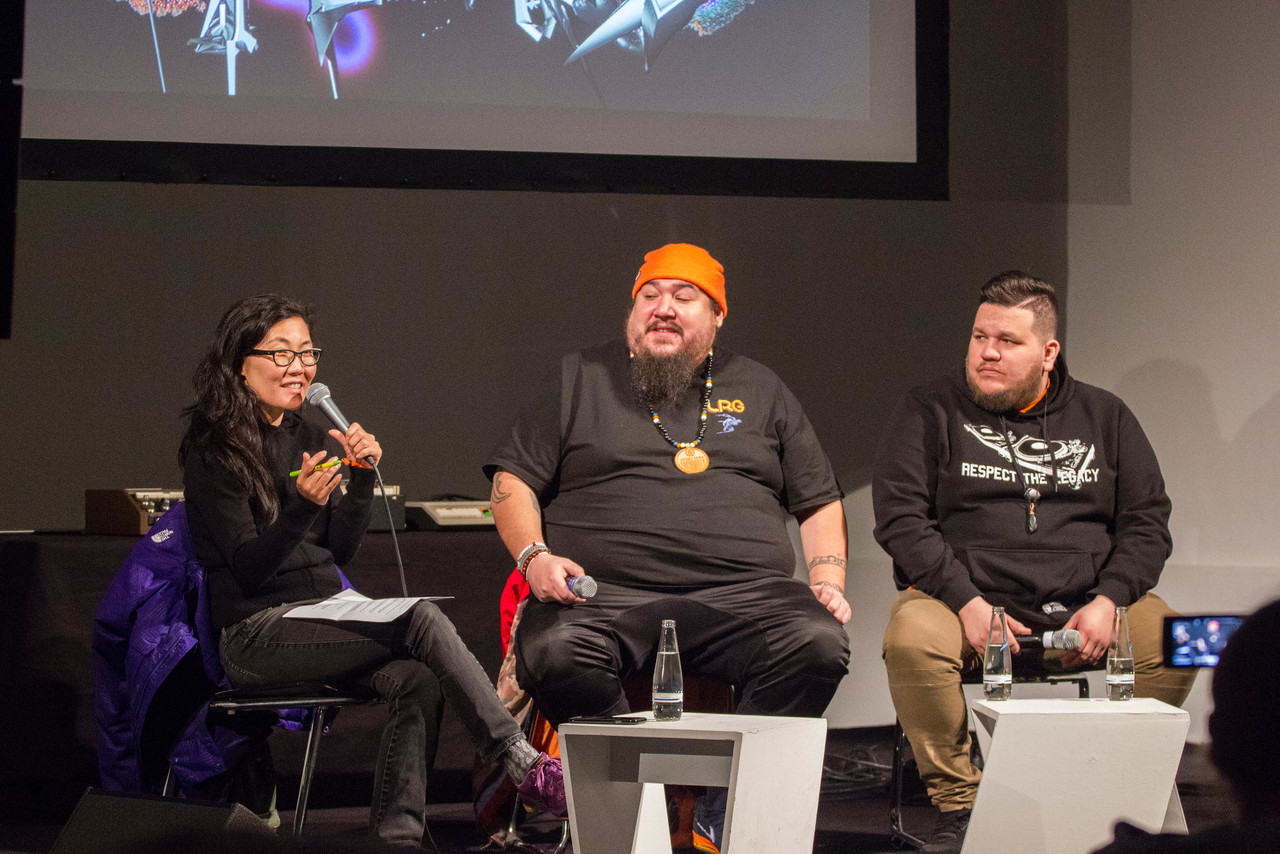
Jas M. Morgan caught up with ATCR’s Bear Witness ahead of their appearance at CTM 2019 to speak about how the group got started, how they see their role in shaping modern Indigenous identity, and to explore some of their wide-ranging artistic collaborations.
Jas M. Morgan: For folks who don’t know a lot about you out in Berlin, your work is so multidisciplinary. I'm wary of describing it as »just« a DJ project. Can you give an overview of how you guys work together and how you produce together?
Bear Witness: A Tribe Called Red has its roots in club DJing. But right from the start we were at a place where all of us played on different equipment. One guy on turntables. And myself on a MIDI controller. Another guy on CDJs. So we just always had all this gear set up. The idea of kind of playing together in a way that was more than just three DJs taking turns was something that came up right away at the Electric Pow Wow parties that we started here in Ottawa. That idea has evolved over the years into what we have now, with myself and 2oolman. It’s still based in DJing but it’s become more and more of a band, in a sense. I’m the only DJ on stage now, really. 2oolman is doing live remixing and playing the MPC. We started to bring the MOOG on the road and stuff. There’s a lot more of a live aspect that has begun to be woven into the DJ set. And then, we have the live visuals aspect, which has always added another layer. We try to offer something more than just a couple DJs playing turntables. At the end of the day we’re just a couple of guys standing at a table and it’s hard to make that interesting outside of your usual kind of clapping and drumming around kind of stuff. Having visuals adds more to look at but also gives us an opportunity since our music is party music, it’s club music. But there’s always been more of a message to what we’ve been doing. Visuals have always given us an opportunity to add in a very fun way at times, but still adding to the conversation of Indigenous representation and Indigenous issues. The most recent thing we’ve added to our live set is dancers. We’ve had dancers now for about five years or even more. The group of dancers we’re working with now was already doing that same kind of work we’re doing with music in their dance practice. Lunacee and Creeasian both practice traditional Pow Wow dancing as well as street dance. You’ll see Lunacee in her traditional regalia doing various different dances: fancy shawl and jingle dress. And Creeasian does grass dance. So you’ll see them both in their traditional regalia. But then they’ll change into their street clothes and do break- and house-dancing, those sort of things. And then you’ll even see them in an in-between kind of mode, where they’re sort of in half traditional regalia and half street clothes. These are all very visual representations of what we’re doing with our music as well.
JM: This is a cool festival to house your work because it thinks about the interactions of music and visual art. I know these disciplinary definitions can be very complex for Indigenous peoples. I’ve heard you call both your art and musical work remixes. I was wondering, how has A Tribe Called Red helped you find your identity as a musician and artist?
BW: The work around identity as an urban Indigenous person has been lifelong for me. Even longer than my lifetime. It extends to my parents and my grandparents. All of whom are artists in different disciplines. All of their work has always had a common thread: the urban Indigenous experience. And, really, their generation was asking those questions: what does the urban Indigenous experience look like and what could that be? Throughout my life I’ve seen it define itself and become a real community. We’re a big part of that. We’re a part of helping solidify that identity as urban Indigenous peoples. So, a bigger part than discovering my own identity through the work, has been the part of defining this generation of urban Indigenous people. I feel like we follow more than we lead with A Tribe Called Red. It might look from the outside that it’s the other way around. But our following – the things we see our community needs, that our community wants – this community is able to represent ourselves the way we see ourselves. The way we are seeing ourselves is very important to our community. So that’s what we go out in the world and do.
JM: You brought up Electric Pow Wow earlier. I went to the one right after you were nominated for the Juno and it was such a banger. I always think about A Tribe Called Red as being for the cool, fashionable neechies (the word in the Anishinabemowin language for »cousins«) who live in the city. Do you think about that? Kind of like the way Drake does with Toronto? Do you think about Ottawa and the city community there as really formulating and being a part of A Tribe Called Red?
BW: In our early years we started the Electric Pow Wow party without a lot of expectation and without a lot of foresight into what it could mean and be. But its meaning was very quickly shown to us by the people here in Ottawa in the Indigenous community. They told us what it meant and that it was something that we needed to continue doing. So it’s always had that feeling of being a community-led project. Things have definitely changed over the years. Unfortunately we don’t have that Electric Pow Wow party anymore and we’re in a very different position, but that’s where things started.
JM: Listening to A Tribe Called Red is so cool because of all the collaborations that you include on your record. Do you have any cool or funny collaboration stories?
BW: Working with Yasiin Bey was one of the crazier collaborations we’ve gotten to do. And, like many of our collaborations, it stretched out over a year, from the time that we met to him coming out on the stage at Montreal’s Osheaga festival during our set and performing with us there, with Narcy as well.
JM: I was there! That was so cool.
BW: Ya, that was wild! He wasn’t even supposed to be in town, he just happened to show up.
JM: I know! He just kept jumping on stages and it was like, are you here?
BW: And then they scored a set because somebody got cancelled. So he ended up doing a whole set too. So there was that meeting. There were several meetings that led up to us actually working together. And even just that was a really crazy experience. After we had recorded the song »R.E.D« there was that time period when he was stuck in South Africa under house arrest, which meant that for the video we wanted to shoot, we had to go to him. We found a way to weave that into the Halluci Nation story we were trying to tell, and we were going to try to help him escape. After we made the video for »R.E.D.,« we watched it. There’s a middle part where they are actually escaping. A few months before that had happened, my grandfather had passed away. He was a holocaust survivor. He was born in Paris. He was sent away by his mother before anything happened to him. He was sent away. He had to escape in a cart, kind of thing, into the demilitarised zone. So, when I was watching the video after, I realised we kind of told his story in this video.
But back to the collaboration part of it. Working with Yasiin was nuts because he’s a very on person. It was trying to herd cats in a sense, getting him into the actual studio. It was awesome! We were talking. We were having a great time. Part of the collaboration process is telling stories and sharing your background with people. Even just getting to know people so you feel more comfortable in the studio. But for the recording process, you have an hour or two a day of the entire day. At one end, why are you complaining? You're in a studio with Yasiin Bey telling you crazy stories and being awesome. But me, being kind of pragmatic about the situation, I was like, »OK, we gotta get this guy in there.« We finally get him into the studio and he’s like, »Where’s Ruby?« And that’s when we find out that he has this special mic named Ruby and it’s the only mic he records on. He then disappeared for another three hours to go and get it. But when he finally got back with Ruby and everything, he finally dropped this amazing verse. What more could we have asked for in a Yasiin Bey verse, than what we ended up getting?
JM: Is there anything else you wanted to say to your audience in Berlin?
BW: We’re excited to be coming back to Berlin.